Commercial sod installation is the process of preparing, grading, and laying professionally grown turf on business properties to create an immediate, functional green space. For property managers and business owners in Port Coquitlam, understanding how this process works can help you budget accurately, avoid common pitfalls, and get lasting results from your investment. In this guide, we break down each stage of a commercial sod project, from soil assessment to post-installation care, drawing on our 34 years of experience across the Tri-Cities.
Why Do Port Coquitlam Businesses Choose Sod Over Seeding?
When it comes to commercial landscaping services, time matters. Seeded lawns can take 8 to 14 weeks to establish, during which foot traffic, erosion, and weed pressure threaten the outcome. Sod delivers a finished lawn in a single day.
For commercial properties along Lougheed Highway and in growing mixed-use areas like Lincoln Park and Central Port Coquitlam, that speed translates directly to reduced disruption. Retail plazas, office complexes, and strata developments need curb appeal that works on a construction timeline, not a growing season.
Sod also performs better in Port Coquitlam’s clay-heavy lowland soils. Because turf is pre-grown with an established root system, it resists the washout that often ruins seeded areas during our heavy fall and winter rains. The B.C. Landscape and Nursery Association (BCLNA) recommends sod for sites where erosion control and rapid establishment are priorities.
What Does the Commercial Sod Installation Process Look Like?
A proper commercial sod installation follows a sequence of steps that we have refined over three decades of work across strata complexes, business parks, and municipal properties.
Step 1: Site Assessment and Soil Testing. We evaluate the existing grade, drainage patterns, soil composition, and sun exposure. In Port Coquitlam, this is especially important because soil conditions vary dramatically. Properties in Oxford Heights and Citadel Heights often sit on well-drained, gravelly substrate, while sites closer to the Pitt River in Riverwood and Mary Hill deal with heavy clay and seasonal waterlogging.
Step 2: Site Preparation and Grading. Old turf, debris, and weeds are stripped. The subgrade is regraded to ensure positive drainage away from buildings and hardscapes. According to the Government of British Columbia’s Stormwater Planning Guidebook, proper surface grading is a frontline strategy for managing urban runoff.
Step 3: Soil Amendment. Based on soil test results, we amend the topsoil layer. Port Coquitlam’s naturally acidic soils often need lime to adjust pH, plus compost to improve structure. For clay-heavy sites, we incorporate sand and organic matter to create a permeable growing medium. This is where many budget-focused contractors cut corners, and it is exactly where long-term turf health is won or lost.
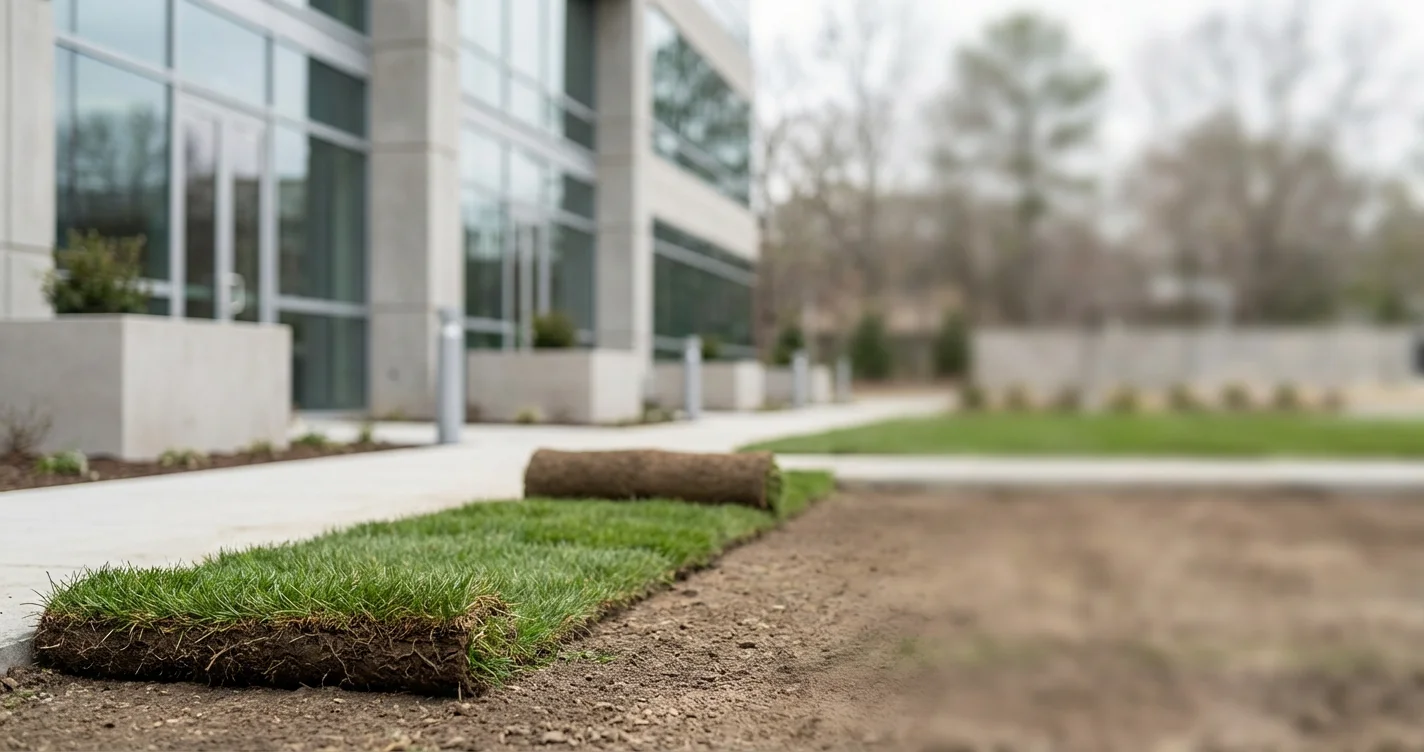
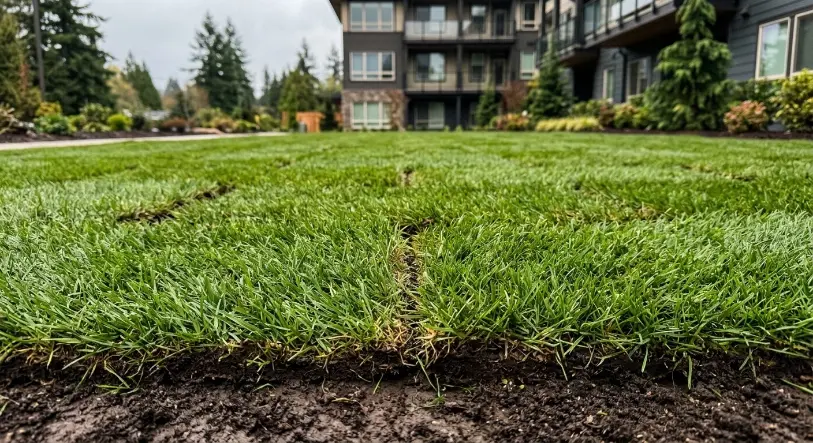
Step 4: Laying the Sod. Rolls are installed tightly against each other, staggered like brickwork, with no gaps or overlaps. On slopes, we stake the sod to prevent slippage. Our uniformed crews follow B.C.L.N.A. standards for installation, ensuring each roll has full soil contact.
Step 5: Rolling and Initial Watering. A heavy roller presses the sod against the prepared soil to eliminate air pockets. We then saturate the new turf. During Port Coquitlam’s drier spring and summer months (roughly May through September), irrigation scheduling is critical for the first two weeks.
How Much Does Commercial Sod Installation Cost in Port Coquitlam?
The cost for landscaper services on a commercial sod project depends on several variables: site size, accessibility, soil condition, the turf variety selected, and whether demolition of existing surfaces is required.
As a general range, business landscaping projects involving sod in the Tri-Cities area typically fall between $2.50 and $5.00 per square foot, installed. That includes soil preparation, amendments, sod material, and labour. Larger properties, such as strata complexes or commercial parks near the Mary Hill Bypass corridor, often benefit from volume pricing.
Factors that push costs higher include steep slopes, poor drainage requiring subsurface tile, contaminated fill that needs removal, and limited equipment access. We provide detailed written estimates before any work begins, because our promise is to do landscaping work right the first time, on time and on budget.
For a personalized quote, we recommend starting with a free consultation so we can assess your specific site.
What Turf Varieties Work Best for Commercial Properties Here?
Not all sod is equal, and the Pacific Northwest climate in Port Coquitlam creates specific demands. Our region sees roughly 1,500 mm of annual rainfall, mild winters, and moderate summers. The right turf variety needs to handle shade, moisture, and moderate foot traffic.
Kentucky Bluegrass blends are the most common choice for commercial landscape installation in the Lower Mainland. They establish quickly, self-repair through rhizome growth, and maintain a dense, attractive appearance year-round.
Perennial Ryegrass blends are ideal for high-traffic areas like pathways, common areas around PoCo Place Shopping Centre, and properties near the Traboulay PoCo Trail that see heavy pedestrian use. Ryegrass germinates and fills in fast.
Tall Fescue blends suit sites with partial shade and less irrigation. For properties backed by tree cover in areas like Birchland Manor or along Colony Farm Regional Park, fescue tolerates lower light and less water.
The Turfgrass Producers International provides research-backed guidance on variety selection by climate zone, and we use their recommendations alongside our own decades of local experience.
How Should You Maintain Commercial Sod After Installation?
Installation is only the beginning. Without proper commercial property landscape maintenance, even the best sod job will decline within a season. Here is what the first year looks like.
Weeks 1 to 2: Establishment watering. Water twice daily to keep the sod moist but not waterlogged. In Port Coquitlam’s summer months, this typically means early morning and late afternoon irrigation cycles.
Weeks 3 to 4: Transition watering. Reduce frequency to once daily, then every other day. The goal is to encourage roots to grow downward into the amended soil.
First mowing (week 2 to 3). Mow when the turf reaches 3.5 to 4 inches. Set the mower to remove no more than one-third of the blade height. Sharp blades are essential to avoid tearing new grass.
Ongoing care. Fertilize according to a seasonal schedule. In our Pacific Northwest climate, fall fertilization (September to October) is the most important application because it fuels root growth heading into winter dormancy. Spring feeding (March to April) supports green-up and density.
For properties that need regular professional care, our landscape maintenance and lawn care programs cover mowing, fertilization, aeration, and seasonal cleanups.
When Is the Best Time to Install Commercial Sod in Port Coquitlam?
Our peak season runs from March through November. The ideal windows for sod installation are:
Spring (April to June). Warm soil, longer days, and regular rainfall create perfect establishment conditions. This is the most popular time for new construction projects and strata renovations across the Tri-Cities.
Early fall (September to October). Cooler temperatures reduce water demand, and fall rains handle much of the irrigation naturally. Root growth continues through mild Lower Mainland winters.
Summer (July to August). Installation is possible but requires more aggressive irrigation. For properties with reliable irrigation systems, summer projects can work well.
We do not recommend installing sod during the dormant period (December to February) because cold, saturated soils delay root establishment.
Frequently Asked Questions
How long does it take to install sod on a commercial property?
Most commercial sod projects take one to three days depending on property size and preparation needs. A typical 5,000 to 10,000 square foot site, common for strata properties and business parks in Port Coquitlam, is usually completed within two days including soil prep.
Can sod be installed on top of existing grass?
No. Existing turf, weeds, and debris must be stripped and removed before installation. Laying sod over old grass creates an organic layer that prevents root contact with the soil, leading to poor establishment and early failure.
How soon can people walk on new sod?
Light foot traffic is acceptable after about two weeks. Heavy use and regular maintenance traffic should wait until the sod has rooted firmly, typically three to four weeks after installation. You can test this by gently pulling a corner of the sod. If it resists, roots have anchored.
Does Terra Firma handle both installation and ongoing maintenance?
Yes. We provide full-service commercial landscaping that covers everything from initial installation through year-round maintenance. With 100+ strata properties under our care, we understand what it takes to keep commercial turf looking professional across every season.
Ready to Get Started?
Terra Firma Lawn & Garden has been serving Port Coquitlam and the Tri-Cities since 1992. We are WorkSafeBC certified, fully insured, and committed to organic, chemical-free practices.
Google Rating: 4.2 stars (16 reviews)
Our promise: to do landscaping work right the first time, on time and on budget.